


1. Introduction
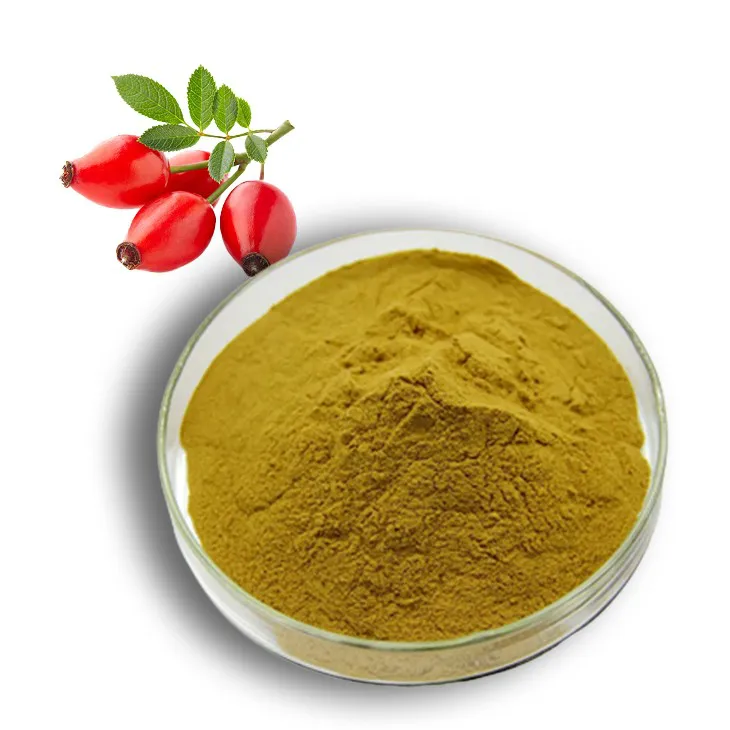
Rose hips are the fruit of the rose plant and are known to be rich in various nutrients, with Vitamin C being one of the most prominent components. Vitamin C, also known as ascorbic acid, plays a crucial role in human health, including antioxidant functions, collagen synthesis, and immune system support. Extracting, separating, and identifying Vitamin C from Rose Hip Extract are important not only for the quality control of products containing rose hips but also for further research on their potential health - promoting effects.
2. Extraction Process
2.1 Traditional Extraction Methods
2.1.1 Maceration
Maceration is one of the simplest traditional extraction methods. In this process, rose hips are crushed or powdered and then soaked in a solvent, usually water or an alcohol - water mixture, for a certain period. The solvent penetrates the plant material, and the soluble components, including Vitamin C, are dissolved. However, this method has relatively low extraction efficiency. It may take a long time to achieve a satisfactory extraction yield, and there is a risk of degradation of Vitamin C during the long - extraction period. For example, if the extraction process lasts for several days at room temperature, some of the Vitamin C may be oxidized due to exposure to air and the presence of enzymes in the rose hips.
2.1.2 Decoction
Decoction involves boiling rose hips in water. This method can accelerate the extraction process compared to maceration. The heat helps to break down the cell walls of the rose hips more quickly, releasing the Vitamin C into the water. However, the high temperature can also cause some problems. Vitamin C is heat - sensitive, and excessive heat can lead to its decomposition. Therefore, careful control of the boiling time and temperature is required to optimize the extraction of Vitamin C while minimizing its degradation. For instance, boiling rose hips for too long may significantly reduce the Vitamin C content in the extract.
2.2 Modern Extraction Methods
2.2.1 Supercritical Fluid Extraction (SFE)
Supercritical fluid extraction is a more advanced extraction method. In this process, a supercritical fluid, usually carbon dioxide, is used as the solvent. Supercritical carbon dioxide has properties between a gas and a liquid, which allows it to penetrate the rose hip matrix effectively and extract the target compounds, such as Vitamin C. One of the main advantages of SFE is its selectivity. It can be adjusted to preferentially extract Vitamin C while leaving behind other unwanted components. Additionally, since carbon dioxide is a non - toxic, non - flammable gas, it is a more environmentally friendly solvent compared to organic solvents used in some traditional methods. Moreover, the extraction can be carried out at relatively low temperatures, which helps to preserve the integrity of Vitamin C. However, the equipment for SFE is relatively expensive, which may limit its widespread application in small - scale or low - budget extraction operations.
2.2.2 Ultrasonic - Assisted Extraction (UAE)
Ultrasonic - assisted extraction utilizes ultrasonic waves to enhance the extraction process. When ultrasonic waves are applied to the rose hip - solvent mixture, cavitation bubbles are formed and then collapse. These collapses create local high - pressure and high - temperature regions, which help to break the cell walls of the rose hips more effectively, thus increasing the release of Vitamin C into the solvent. UAE has the advantages of shorter extraction time and higher extraction efficiency compared to traditional methods. It can also be carried out at relatively low temperatures, reducing the risk of Vitamin C degradation. For example, in a study comparing UAE with traditional maceration, UAE was found to achieve a higher Vitamin C extraction yield in a shorter time period.
3. Separation

3.1 Filtration
Filtration is a commonly used separation method in the processing of Rose Hip Extract. It is used to remove solid particles from the extract. There are different types of filtration, such as gravity filtration and vacuum filtration. Gravity filtration is a simple method where the extract is passed through a filter paper or a porous medium under the force of gravity. It is suitable for removing larger particles. Vacuum filtration, on the other hand, uses a vacuum pump to create a pressure difference, which speeds up the filtration process. This method is more efficient for removing finer particles. However, filtration may not be sufficient to completely separate all impurities from the Vitamin C - containing extract. Some dissolved impurities may still remain in the filtrate.

3.2 Centrifugation
Centrifugation is another separation method that can be used for Rose Hip Extract. In this process, the extract is placed in a centrifuge tube and spun at a high speed. The centrifugal force causes the denser particles to sediment at the bottom of the tube, while the supernatant, which contains the Vitamin C, can be separated. Centrifugation is effective for separating particles that are difficult to remove by filtration, such as very fine particles or colloidal particles. However, like filtration, it may not be able to completely separate all unwanted substances. For example, if there are substances with similar densities to Vitamin C in the extract, they may not be effectively separated by centrifugation alone.
3.3 Chromatographic Separation
Chromatographic separation is a more advanced and selective separation method. There are different types of chromatography, such as column chromatography and high - performance liquid chromatography (HPLC). In column chromatography, the Rose Hip Extract is passed through a column filled with a stationary phase. Different components in the extract, including Vitamin C, interact differently with the stationary phase and are thus separated as they move through the column. HPLC is a more sophisticated version of chromatography that can achieve very high separation efficiency. It is often used for the purification of Vitamin C from Rose Hip Extract, especially when high - purity Vitamin C is required for further analysis or for use in pharmaceutical products. However, chromatographic methods are relatively complex and require specialized equipment and trained operators.
4. Identification
4.1 Chemical Identification Methods
4.1.1 Redox Reaction - based Identification
One of the common chemical identification methods for Vitamin C is based on its redox properties. Vitamin C is a strong reducing agent. It can react with oxidizing agents such as iodine. In a typical reaction, iodine solution is added to the Rose Hip Extract. If Vitamin C is present, it will reduce the iodine to iodide ions. The reaction can be monitored by observing the change in color. The iodine solution has a brown color, and as it is reduced by Vitamin C, the color fades. This method is relatively simple and can be used for a quick qualitative determination of the presence of Vitamin C in the extract. However, it may be affected by other reducing substances in the extract, which can lead to false - positive results.
4.1.2 Reaction with 2,6 - Dichlorophenolindophenol (DCPIP)
DCPIP is a dye that can be used to identify Vitamin C. DCPIP has a blue color in its oxidized form. When it comes into contact with Vitamin C, which is a reducing agent, DCPIP is reduced to its colorless form. By adding a small amount of DCPIP solution to the Rose Hip Extract, the presence of Vitamin C can be determined by observing the change in color from blue to colorless. This method is also relatively simple and sensitive, but similar to the iodine method, it may be influenced by other reducing substances in the extract.
4.2 Physical Identification Methods
4.2.1 Spectrophotometric Analysis
Spectrophotometric analysis can be used to identify and quantify Vitamin C in Rose Hip Extract. Vitamin C has characteristic absorption spectra in the ultraviolet region. By measuring the absorbance of the extract at a specific wavelength in the ultraviolet range, the concentration of Vitamin C can be determined. This method requires a spectrophotometer, which is a relatively expensive piece of equipment. However, it can provide accurate quantitative results if the sample preparation and measurement conditions are properly controlled. Additionally, the presence of other substances in the extract that absorb at the same wavelength may interfere with the measurement, so appropriate sample purification steps may be necessary before spectrophotometric analysis.
4.2.2 Nuclear Magnetic Resonance (NMR) Spectroscopy
NMR spectroscopy is a powerful tool for identifying the structure of compounds, including Vitamin C. It provides detailed information about the chemical environment of atoms in the molecule. In the case of Vitamin C, NMR spectroscopy can be used to confirm its presence in Rose Hip Extract by analyzing the characteristic peaks in the NMR spectrum. However, NMR spectroscopy is a complex and expensive technique that requires highly trained operators and specialized equipment. It is mainly used for in - depth structural analysis and identification in research laboratories rather than for routine quality control in industrial settings.
5. Conclusion
In conclusion, the extraction, separation, and identification of Vitamin C in Rose Hip Extract are important processes. The choice of extraction method depends on factors such as extraction efficiency, product quality, and cost. Modern extraction methods such as supercritical fluid extraction and ultrasonic - assisted extraction offer certain advantages over traditional methods in terms of efficiency and preservation of Vitamin C. In separation, different methods like filtration, centrifugation, and chromatographic separation can be used depending on the purity requirements of the final product. For identification, both chemical and physical methods are available, each with its own advantages and limitations. Accurate identification of Vitamin C is crucial for the quality control of rose - hip - based products and for further research on their health - promoting effects. Future research may focus on developing more efficient and cost - effective extraction and separation methods, as well as improving the accuracy and simplicity of identification methods.
FAQ:
What are the traditional extraction methods of Vitamin C in Rose Hip Extract?
The traditional extraction methods of Vitamin C in Rose Hip Extract may include solvent extraction. For example, using organic solvents like ethanol. This method is relatively simple but may have some limitations in terms of extraction efficiency and selectivity.
How do modern extraction methods improve the extraction of Vitamin C from rose hip?
Modern extraction methods, such as supercritical fluid extraction, can improve the extraction of Vitamin C from rose hip. Supercritical fluid extraction uses substances in a supercritical state, which has better solubility and diffusivity. It can often achieve higher extraction efficiency and better preserve the quality of Vitamin C compared to traditional methods.
What are the advantages of filtration in the separation of Vitamin C in Rose Hip Extract?
Filtration in the separation of Vitamin C in Rose Hip Extract has the advantage of removing solid impurities effectively. It can separate larger particles from the extract solution, making the subsequent processing steps easier and helping to purify the Vitamin C - containing solution.
How does centrifugation contribute to the separation of Vitamin C in Rose Hip Extract?
Centrifugation can separate substances based on their density differences. In the case of Rose Hip Extract, it can help to separate components with different densities, including separating the Vitamin C - rich fraction from other denser or lighter substances, which is beneficial for purifying Vitamin C.
What are the chemical methods for identifying Vitamin C in Rose Hip Extract?
One chemical method for identifying Vitamin C in Rose Hip Extract is the redox reaction. Vitamin C is a strong reducing agent. It can react with substances like iodine, and the change in the amount of iodine can be used to determine the content of Vitamin C. Another method is the reaction with certain metal ions, such as the reaction with copper ions to form a colored complex.
Related literature
TAGS:


-

Vitamin B9 powder
2024-12-07
-

Honeysuckle Pollen
2024-12-07
-

Green Tea Extract
2024-12-07
-

Sea buckthorn oil
2024-12-07
-

Ginseng Root Extract
2024-12-07
-

Peppermint Extract Powder
2024-12-07
-

Curcumin
2024-12-07
-

Hericium erinaceus extract powder
2024-12-07
-

Mango flavored powder
2024-12-07
-

Vitamin B9
2024-12-07