


Introduction
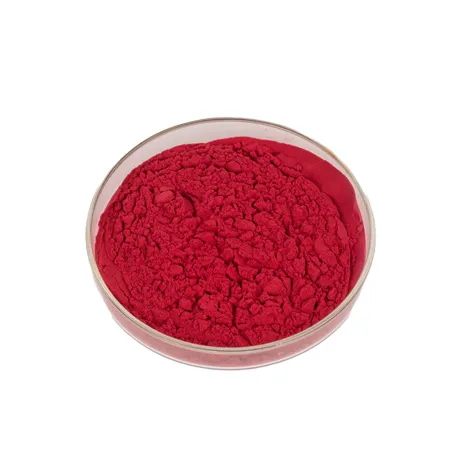
Cranberries are well - known for their numerous health benefits, and Cranberry Extract powder has become a popular ingredient in various industries, including food, dietary supplements, and pharmaceuticals. The 80 - 100 mesh specification of Cranberry Extract powder is of particular interest due to its unique properties related to product quality, solubility, and bioavailability.
The Significance of 80 - 100 Mesh Size
Product Quality
The 80 - 100 mesh size of Cranberry Extract powder plays a crucial role in determining the overall product quality. Mesh size refers to the number of openings per linear inch in a screen through which the powder is sieved. In this case, a powder in the 80 - 100 mesh range indicates that the particles are relatively fine, which can result in a more consistent and homogeneous product. Finer particles are less likely to contain large lumps or aggregates, ensuring a smooth texture and uniform appearance. This is especially important in applications where the powder is used in formulations that require precise mixing, such as in the production of dietary supplements where accurate dosing of active ingredients is essential.

Solubility
Solubility is another key aspect influenced by the mesh size. The 80 - 100 mesh Cranberry Extract powder generally exhibits better solubility compared to coarser powders. The finer particles have a larger surface area - to - volume ratio. When the powder comes into contact with a solvent (such as water in the case of most applications), the increased surface area allows for more efficient interaction between the solvent molecules and the active compounds in the Cranberry Extract. This leads to faster dissolution, which is highly desirable in products like instant beverages or liquid - based dietary supplements. For example, in a cranberry - flavored drink mix, a more soluble Cranberry Extract powder can quickly and evenly disperse, providing a consistent flavor and ensuring that the beneficial compounds are readily available for absorption.
Bioavailability
Bioavailability, which is the extent to which a substance is absorbed and can have an active effect in the body, is also affected by the mesh size. The finer particles of 80 - 100 mesh Cranberry Extract powder can potentially enhance bioavailability. Once ingested, the smaller particle size may facilitate easier passage through the digestive system and quicker absorption by the body's cells. This is because the finer particles can be more easily broken down by digestive enzymes and have a higher probability of coming into close contact with the absorptive surfaces in the intestines. In the context of cranberry's health - promoting properties, such as its ability to prevent urinary tract infections, better bioavailability means that the active components (such as proanthocyanidins) can more effectively reach their target sites in the body and exert their beneficial effects.
Sustainable Sourcing of Cranberries
As the demand for Cranberry Extract powder grows, sustainable sourcing of cranberries becomes increasingly important. Cranberries are typically grown in wetland areas, known as bogs. Sustainable cranberry farming practices involve several key aspects:
- Water Management: Cranberry bogs require careful water management. Farmers need to ensure an adequate supply of water during the growing season while also preventing water waste. Some sustainable farms use advanced irrigation systems that recycle water and monitor water levels precisely to minimize environmental impact.
- Pest and Disease Control: Instead of relying solely on chemical pesticides and fungicides, sustainable cranberry growers are turning to integrated pest management (IPM) strategies. These may include introducing natural predators of pests, using resistant cranberry varieties, and implementing cultural practices such as proper spacing between plants to reduce disease spread.
- Soil Conservation: Maintaining the health of the soil in cranberry bogs is essential. Sustainable farming methods involve adding organic matter to the soil, such as compost, to improve soil structure and fertility. This not only benefits the cranberry plants but also helps to sequester carbon, contributing to climate change mitigation.
- Harvesting Practices: When it comes to harvesting, sustainable cranberry farms aim to minimize waste. Modern harvesting techniques, such as using water - harvesting methods that gently dislodge the berries from the vines, are more efficient and cause less damage to the plants. Additionally, efforts are made to ensure that all harvested berries are of high quality and can be used for extraction, reducing post - harvest losses.
By sourcing cranberries from sustainable farms, manufacturers of Cranberry Extract powder can ensure the long - term availability of this valuable raw material while also reducing their environmental footprint.
Innovative Extraction and Purification Methods

Extraction
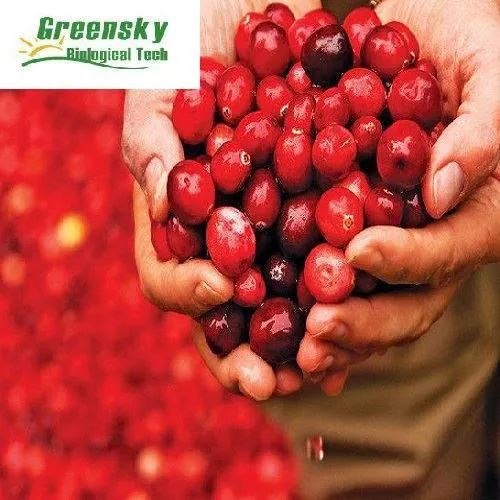
There are several innovative extraction methods used to obtain Cranberry Extract from the berries. One commonly used method is solvent extraction. In this process, a suitable solvent, such as ethanol or water - ethanol mixtures, is used to dissolve the active compounds from the cranberry pulp. The choice of solvent depends on various factors, including the solubility of the target compounds and the safety and regulatory requirements. Ethanol - based solvents are often preferred as they can effectively extract a wide range of bioactive compounds, including proanthocyanidins, flavonoids, and phenolic acids, while also being relatively safe for human consumption at appropriate concentrations.
Another emerging extraction technique is supercritical fluid extraction (SFE). This method uses supercritical carbon dioxide as the extraction solvent. Supercritical carbon dioxide has unique properties, such as low viscosity, high diffusivity, and tunable solvent strength, which make it an excellent choice for extracting Cranberry Extract. The extraction process can be precisely controlled by adjusting the pressure and temperature conditions, allowing for the selective extraction of specific compounds. SFE is also considered a "green" extraction method as it produces no or very little organic solvent waste, making it more environmentally friendly compared to traditional solvent extraction methods.
Purification
After extraction, the Cranberry Extract needs to be purified to remove impurities and concentrate the active compounds. Filtration is a simple yet effective purification method. By passing the extract through filters with different pore sizes, larger particles, such as insoluble solids and debris, can be removed. This helps to improve the clarity and purity of the extract.
Another purification technique is chromatography. There are different types of chromatography, such as high - performance liquid chromatography (HPLC) and column chromatography, that can be used depending on the specific requirements. Chromatography works by separating the components of the extract based on their differential affinities for a stationary phase and a mobile phase. This allows for the isolation and purification of individual bioactive compounds or groups of compounds. For example, HPLC can be used to separate and purify proanthocyanidins from other phenolic compounds in the Cranberry Extract, resulting in a more pure and potent product.
Conclusion
The production of 80 - 100 mesh Cranberry Extract powder is a complex process that involves careful consideration of various factors. The 80 - 100 mesh size offers significant advantages in terms of product quality, solubility, and bioavailability. Sustainable sourcing of cranberries is essential to ensure the long - term viability of this industry, and innovative extraction and purification methods are continuously being developed to improve the quality and efficacy of the Cranberry Extract powder. As the demand for natural and health - promoting products continues to rise, Cranberry Extract powder in the 80 - 100 mesh specification is likely to play an increasingly important role in various applications, from dietary supplements to functional foods.
FAQ:
What is the significance of the 80 - 100 mesh size for Cranberry Extract powder?
The 80 - 100 mesh size is significant for Cranberry Extract powder. A specific mesh size affects the particle size distribution. In this range, it can contribute to better solubility as the relatively smaller particles can dissolve more easily in solvents. Regarding bioavailability, the appropriate particle size can enhance the absorption in the body. It also has an impact on product quality, for example, it can influence the texture and homogeneity of the powder, making it more suitable for various applications such as in dietary supplements or food additives.
How are cranberries sustainably sourced for making this extract powder?
Sustainable sourcing of cranberries for making the extract powder involves several practices. Firstly, many cranberry growers use organic farming methods, which avoid the use of synthetic pesticides and fertilizers. Secondly, there is an emphasis on water conservation in cranberry bogs as cranberries are wetland plants. Some farms also implement integrated pest management to control pests in an environmentally friendly way. Additionally, fair trade practices may be involved to ensure that farmers receive a fair price for their cranberries, which in turn promotes the long - term viability of cranberry production.
What are the innovative extraction methods used to produce 80 - 100 mesh Cranberry Extract powder?
One innovative extraction method is supercritical fluid extraction. Supercritical CO₂ can be used as a solvent. It has the advantage of being non - toxic and can be easily removed from the extract, leaving behind a pure Cranberry Extract. Another method is ultrasonic - assisted extraction. Ultrasonic waves can enhance the mass transfer rate during extraction, which can lead to a more efficient extraction process. Enzyme - assisted extraction is also sometimes used. Enzymes can break down cell walls in cranberries, making it easier to extract the active compounds.
How is the purification process carried out for 80 - 100 mesh Cranberry Extract powder?
The purification process often involves filtration steps. For example, membrane filtration can be used to remove impurities of different sizes. After extraction, centrifugation may be carried out to separate the solid particles from the liquid extract. Chromatography techniques such as high - performance liquid chromatography (HPLC) can also be employed to further purify the extract and separate the desired active compounds from other substances present in the extract.
What are the potential applications of 80 - 100 mesh Cranberry Extract powder?
The 80 - 100 mesh Cranberry Extract powder has several potential applications. In the food industry, it can be used as a natural colorant or flavor enhancer in products like juices, yogurts, and baked goods. In the pharmaceutical and dietary supplement sectors, due to its bioactive compounds such as proanthocyanidins, it can be used for promoting urinary tract health. It may also be used in cosmetics, as Cranberry Extract has antioxidant properties that can benefit skin health.
Related literature
- Production and Quality Control of Cranberry Extracts"
- "Sustainable Cranberry Production: A Review of Current Practices"
- "Innovative Extraction Technologies for Fruit Extracts"


-

Milk Thistle Extract
2024-12-21
-

Dandelion Root Extract
2024-12-21
-

Curcuma Longa Extract/Turmeric extract
2024-12-21
-

Medicinal Marshmallow Extract
2024-12-21
-

Lemon Balm Extract
2024-12-21
-

Yam Extract
2024-12-21
-

Grapefruit Seed Extract Powder
2024-12-21
-

D-Mannose
2024-12-21
-

Maitake Mushroom Extract
2024-12-21
-

Elderberry Extract
2024-12-21